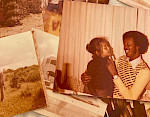
Perhaps research has helped me to come to terms with a kind of mourning, following my father’s disappearance when I was eight, and his actual disappearance some fifteen years later in Ethiopia. As a result, I’ve increasingly come to identify one of the common threads running through my research as a questioning, in the broadest sense, of what it means to inherit, what we inherit, understood here from both a material and emotional point of view, and what we do with it.
In my doctoral thesis, in which the notion of reparation appeared as a question in the title, I looked at how diasporic communities create themselves in an attempt to pick up the pieces of the fragmented, painful histories they have inherited. In this case, it was an investigation into the re-appropriation of dispersed Somali photographic archives, paralleling the diaspora of individuals, which set in motion narratives and questions about identities, transmission and the writing of history. Although I didn’t make it clear, the “subjects investigated” were, in a way, my own doubles, since that’s all I’d been doing since childhood: patching together, from a few scattered fragments of a history with holes in it.
The material traces at my disposal were the family albums I’d leafed through a thousand times, the blue-and-red-edged postcards and transcontinental letters with their paper, a kind of watermark, so special to the touch; cassettes and 45 and 33 rpm records; my father’s books, where a diptych in particular took pride of place: the autobiographies of Malcolm X and Angela Davis, for which he had a special twin binding made, marking their special place for a whole generation on both sides of the Atlantic; a giant historical map of Somalia made (in the 1950s?) by the Istituto geografico italiano: a long-term loan from an ‘uncle’ who had obtained it somehow and was threatening to take it away from us; two wooden statuettes that followed me wherever I moved, identified as “father and son” (the first, taller, with a stylized beard): my father had told us that they should always be placed face to each other, so that they (they?) talk to each other; the snatches of conversation I picked up here and there; the things I knew and all the stories I hoped to gather later, but also the glances in the street and the insistent questions of people I met, in the course of ordinary days, at the post office, the supermarket, the university, curious to know where I’d come from, questions to which for a long time (and sometimes still today) I obliged myself to answer as a good student, while wondering where they’d come from, and what exactly their imperiousness meant. At the time, I hadn’t yet left my hometown, so the question seemed (relatively) incongruous. “It was in the United States and the English-speaking Caribbean that I declared myself to be French and that people believed me”, writes Maboula Soumahoro.
To tell the truth, these inquisitive questions, which basically demanded that “we explain ourselves”, and the looks I was subjected to, echoed other looks, or rather a traffic in clandestine looks that was renewed every time I passed a black person in the street. This exchange or smuggling of glances moved me. I sensed that they too were part, in their own way, of this “vagabond history” of the political solidarities of the black worlds that I would later come to know through books. I rejoiced in this secret: powerful, because invisible to all but the two people involved; fleeting, existing only long enough to meet his gaze, before moving on; intense, without a word being exchanged.
Asking what we inherit and, above all, in what ways we inherit is perhaps a way of appropriating, reweaving and reconfiguring in other ways, in a word of transforming for the future this sum of experience, in order to think how it shapes and obliges us, and how we renegotiate - often by bifurcating - this legacy. This issue is thus interested in the processes by which we inherit (the meaning of which is captured so well in the English language by the gerund of the verb ‘to inherit’ - inheriting - which points to action in the process of unfolding) to understand how they displace us and produce new relationships and questions.
For a long time, I didn’t have the concepts, let alone the words, to understand and above all express my situation. On my mother’s side of the family, I was familiar with my heritage, which can be traced back to the Second World War, anti-fascism, the PCI (‘Il partito’ as it was then called: the Italian Communist Party) and the landless peasants. Heritage, on the other hand, was a nebulous, elusive affair. I was eight years old in 1984, the year of the famine in Ethiopia, of the Band Aid “Do they know it’s Christmas time?”, the year of shame. Even more infamous: the shame of being ashamed.
My questioning, my doubts, but also all my hopes of trying to understand my family history contained within a much greater geopolitical story of pain, were first anchored in objects. I should say in the few I had. Their tiny dimension is important, but they were sources of gigantic questions and imaginations. It meant doing a lot with very little. We had to recover all that was missing, recover in order to know, to become at last: these three interrelated verbs cover constantly fabricated attempts, always declined in a future, deferred time. In reality, it was a mission impossible. So we had to come to terms with the holes and the stutterings, walk with them, and accept them as an integral part of this forever unstable becoming.
This led me to take a later interest - without immediately seeing the link with my earlier research - in the generation which, immediately after independence, tried to (re)build itself, including through the recovery of and demand for material things. As Derek R. Peterson writes: “Heritage always involves reclamation.” From this interest arose my work on the trajectory of Joseph Murumbi (1911-1990), an Indo-Kenyan politician who, in parallel with the anti-colonial and anti-imperialist struggle, formed from the 1950s onwards a collection that he conceived as pan-African. Today, part of this collection is on display at the National Archives of Kenya in Nairobi, an archive that Murumbi himself helped to establish in 1966, believing that “it is time that, as independent countries, we protected by legislation what belongs to us and what should remain in this country”. He was referring to the Mau Mau archives removed and destroyed by the British before independence. The imposing building that houses them today, in Nairobi’s administrative and business center, was once the headquarters of the Bank of India during the British Empire. The transmutation of value - from one form of capital to another - never ceases to fascinate me. Joseph Murumbi had a dream, still pioneering and unfulfilled today. He wanted his collection of so-called ethnographic artifacts, works by African artists, his library and archives to become the heart (the reactor?) of a pan-African center for African studies, giving students from across the continent access in situ to the sources they needed to write their own history. His political imagination thus gave objects, artefacts and works of art the same power to germinate knowledge as books and archival documents. Elsewhere I have referred to this mixed collection, which allows for unlimited combinations and thus the writing of a potentially infinite number of histories, as “an ouvroir d’histoires (de l’art) potentielles”
In the same spirit, this fourth issue of the journal attempts to interweave the histories, questions and social relations that are woven around museum objects, with those of other collections - of books, archives and sounds - collected, produced and transmitted by the knowledge-producing institutions that house them: libraries and universities. The latter also call for the development of new practices and methodologies that can undo instituted classifications, in order to augment, densify, intensify and reconnect with other histories, experiences and narratives that tell in a more complex way what connects us to previous generations - the traumas but also the dreams of history - and what we make of them in order to act in the future.
To take an interest in the multiple ways in which we inherit is also to summon and weave new relationships with the dead and the disappeared, the absent, and to undertake processes of storytelling, vigil and comfort in order to try to understand “what has endured from this history”, as Saidiya Hartman writes. For, if we follow Vinciane Despret, “(…) the dead can, through the questions they force us to think about, activate those who make themselves available to the encounters they provoke. Stories are (…) set in motion. The dead turn those who remain into story-makers. Everything starts to move, a sign that something there is breathing life into it”
To speak of heritage as a process necessarily implies asking the question of transmission, which is also conceived as an active and creative practice between generations, whose perception is not fixed and is transformed in the course of our lives. Likewise, its inter-generational dimension requires us to go beyond the linearity conceived between two successive and direct generations, to open it up to ever more affiliations. “The question of transmission is a question of ethical and political practice (…) It is a forward-looking work, a work of insurrection and elaboration of what is not yet,” writes feminist philosopher Françoise Collin. She notes that relationship is at the heart of this process: “It cannot be understood as the transfer of an object from one hand to another. It requires a double activity: on the part of the one who transmits, and on the part of the one who receives this transmission. (…) Caught up in the interplay of generations, it has to do with the desire of the old, as well as the new. It’s up to the new generations to determine whether they want to inherit and what interests them in that inheritance. It’s up to the old to hear the request, to bend their language towards another language and an exchange in which, each remaining what she is, honoring her own history, nevertheless addresses the other and listens to her address.”
What does it require to accept, or not, an inheritance, or to accept part of it, to claim it or to relinquish it, or even to squander it? What relationships or possibilities for relationships do these choices bring into play, or require us to invent? Or, as Vinciane Despret puts it, what do the dead make us capable of? Sometimes too heavy to bear, sometimes too light, what weight do these legacies carry? How do projects aimed at addressing them transform our relationship to absence, loss and trauma(s)? And in so doing, do they produce or make something else present or available? What interpretations, what translations, what selections do they require, and what affects do they then engage?
This issue, part of a work in progress, extends and translates these questions into the field of Trouble dans les collections, in an attempt to understand how they intersect with the present, the future and the future of collections inherited from colonial and postcolonial history. Here hypertrophied, there composed of scattered fragments, they too have much to do with interrupted, chosen and/or reinvented genealogies, traumas, struggles and desires. To this end, it focuses on the experiences, choices and biases (and their share of doubts, hypotheses, attempts and unresolved questioning) of a number of museum professionals, archivists, researchers and artists, based in Europe and Africa, who have worked in the fields of art, history and culture.In “Reprendre”, the chapter in philosopher Valentin Y. Mudimbe’s The Idea of Africa (1994) dedicated to the arts in Africa, the philosopher Valentin Y. Mudimbe’s work on the arts in Africa is based on his own experience of the history of Africa. Mudimbe devotes to the contemporary arts of Africa, he writes: “I think of it [the word “resume”] firstly in the sense of resuming an interrupted tradition, not out of a desire for purity, which would only testify to the imagination of dead ancestors, but in a way that reflects current conditions. Secondly, reprendre suggests a methodological evaluation, since the artist’s work begins, in effect, with an assessment of the tools, means and projects of art in a social context transformed by colonialism and by currents, influences and fashions from abroad. Lastly, reprendre implies a pause, a meditation, a questioning of the meaning of the two preceding exercises.” If we follow Mudimbe, how do the three phases of this act of taking up again - as a resumption that would not be a repetition of the same; a methodological evaluation; a pause-meditation that reconsiders the scope of the two preceding movements - translate here? Is inheriting a form of “taking back”? What do we decide to take back? And, conversely, how does the act of passing on interact with the act of taking back?
À rebours
If it is a question of understanding how to take charge of this colonial and imperial heritage that continues to produce relations of domination and social relations of race, to which the objects in the museum also bear witness, this issue thinks just as much about this intertwined heritage that has carried so many political utopias, gestures of insurrection and practices of liberation that have emerged from black worlds from the colonial period to the present day. It is on this dimension that the issue provisionally closes, or pauses, as Ntone Edjabe writes in her contribution on the discotheque of filmmaker Sarah Maldoror (1929-2020). Her sound piece propels us along at ten miles an hour, making way for restful clearings and stutters. Thick with dozens of revolutionary figures and places, words and gestures, it doesn’t shy away from the ambivalence and ambiguity of their encounters and departures. In this mixtape, Ntone Edjabe offers us a narrative experiment rich in a thousand digressions like so many openings, reminding us that there are several possible beginnings and “many more triangles”, as he writes, to these stories of the practice of freedom between African, African-American and Afro-Caribbean artists and activists. That there are reprisings, repetitions of motifs - words, sounds and gestures - that aren’t really repetitions at all, because they mean “the same but more”. This idea can perhaps be likened to that of ‘rehearsal’ proposed by Ariella Aïsha Azoulay in her book Potential History. Unlearning Imperialism to refer to the fact that the work of undoing coloniality remains forever unfinished and is, therefore, always to be reprendre. Along with others, she also invites us to think more deeply about the question (of acquiring) human rights that are attached to objects. Indeed, the notion of heritage, like that of patrimony (and matrimony), carries with it the transmission of goods and of rights.
Boomerang
This dossier opens with the words of an elder, the Ghanaian filmmaker Nii Kwate Owoo, born in 1944, who recounts the political context in which he evolved at the time of the making of his seminal film You Hide Me, in 1970, in the reserves of the British Museum. While detailing the multiple lives of this film, which the debate on restitutions and the Black Lives Matter movement have brought back to the forefront of the international scene, fifty years after it was made, the filmmaker brings to light the networks of political solidarity that were woven around the film on both sides of the Atlantic to make, produce and distribute it. A case in point is the exceptional document that Nii Kwate Owoo entrusted to us: the brochure produced by African-American filmmaker Lamar Williams to facilitate distribution in the United States, where the film, which is an essay and a plea, becomes a gas pedal of voices that exchange, discuss and demand. This is what Nii Kwate Owoo is now aiming for, as she plans to translate her film into African languages, in order to move away from a discourse on the restitutions of elites and experts (a central notion, incidentally, of the criticism made in her film) and to contribute to producing a new political awareness among Africa’s working classes.
In this interview, the emotions that the film You Hide Me has aroused and continues to arouse also emerge, superimposed on the emotions experienced by the filmmaker at the very moment of shooting, during the few hours he was allowed to stay in the storerooms, touch the objects and literally breathe them out of the plastic bags or display cases. As such, while the work of emotions runs basso continuo through most of the articles, this issue is intended as the beginning of a longer reflection on the historicity and critical significance of these political emotions vis-à-vis these African objects - anger, joy, sadness and, above all, shame. This, in order to draw out a collective dimension because, as the writer Annie Ernaux notes, “The worst thing about shame is that you think you’re alone in feeling it. “
Museum figures, presences
Much has been said and written about museums as cemeteries, prisons, lazarets, crime scenes, plantations and banks, places of production, accumulation and hoarding of both material and symbolic capital. The objects they contain are described in turn as dead, comatose, slumbering, sequestered, exhibits that require, once their blood content has been recognized, forensic approaches that enable us to write not just their social biographies according to the tried-and-tested method of The social life of things (1986) but, henceforth, their necrographies. In this spirit, how would the museum be transformed if we were to reimagine and practice it also as a place of mourning and repair (“to mourn and to repair”), as proposed by the permanent space “I miss you” imagined by the team at the Rautenstrauch-Joest Museum in Cologne? That is, perhaps, by imagining other ways of relating to these objects perceived as “presences” which themselves generate other relationships, gestures and questions.
But as Nanette Snoep, Carla de Andrade Hurst and Aurora Rodonò, respectively director and “diversity managers” at this museum, ask, how can we reconcile two contradictory imperatives: that of telling the story of colonial violence in the space of the museum, from which it has long been banished in favor of a language of omission, while at the same time paying attention to all those who, through their ordinary life experiences, are all too familiar.How can we do this, while at the same time paying attention to all those who, through their ordinary life experiences, are all too familiar, albeit unwillingly, with its legacy and the effects of racism in the present? Which amounts to asking not only where museums talk, but to whom and with what vocabularies? As civic spaces, how do they take into account the diversity of trajectories, experiences and emotions of those they welcome, beyond the disembodied, overhanging rhetoric of “diversity” and fashionable slogans? “I do not want to see decolonisation become part of Britain’s national narrative as a pretty curio with no substance” wrote Sumaya Kassim in a poignant text in 2017 “or, worse, for decoloniality to be claimed as yet another great British accomplishment. the railways, two world wars, one world cup, and decolonisation.” Conversely, what does this work of “remediation” do and ask of those from minority backgrounds (admittedly, still few in non-subordinate positions, surveillance and housekeeping) who engage in it?
These questions are taken up and reconfigured in young heritage curator Alexandre Girard-Muscagorry’s rereading of Clémentine Deliss’s book The Metabolic Museum (2020), in which she reviews the experiments carried out at Frankfurt am Main’s Weltkulturen Museum when she was its director (2010-2015). In his subjective primer, Alexandre Girard-Muscagorry captures Deliss’s experiences and key ideas, as well as the uncompromising language she used to describe the challenges of this dive into the bowels of the ethnographic museum. In Frankfurt, she imagines it as a domestic space, a place for living, studying and resting, taking into account the ways in which the body, or rather the bodies (of artists in residence, visitors) can move and occupy its space. It also sets up a form of circular self-feeding between the members of this other living body that is the museum (laboratory, storerooms, library, etc.), producing a different kind of energy for the collection. The collection is no longer conceived in terms of accumulation: a way of putting an end to the paradigm of the series and the fantasy of the collection’s completeness that the museum has inherited from its history. Writing in the first person, Alexandre Girard-Muscagorry explains in his contribution how this reading nourishes and worries his own curatorial practice, particularly in his core business of conservation. How does loss come into view? “**
The contribution by Sam Hopkins and Simon Rittmeier dialogues with the questions posed in the preceding contributions, but from the perspective of their preliminary and temporary position as artists working, for a time, in the museum. Over the last few years, I’ve shared a ghost collective with them, as part of the International Inventories Programme, where we’ve put together publications and ‘seances’, which was yet another way of summoning the disappeared and the absent into our questioning of the museum.
In the video A Topography of Loss (2021), which they present here, we follow the materiality of the gestures of workers in a kanga factory near Nairobi, producing this popular print in Kenya and East Africa’s Swahili region. The kanga that takes shape before our eyes reproduces, in its central motif, the negative of the physical space occupied by an object - in this case, a kamba belt from Kenya - in the hi-tech storerooms of Cologne’s Rautenstrauch-Joest Museum. The progressive linking of these negative spaces reveals, in the eyes of the artists, a landscape of loss. In the reflection on the artistic research process that accompanies this video, they raise at least three questions. On the one hand, they revisit the question of the rights (and responsibilities) attached to this civic collection, of which they are also the heirs as citizens of the city of Cologne: rights that sketch, in hollow, the non-rights of “others”. Secondly, they ask what relationship the museum has with the value represented by this research, which has itself developed from the symbolic and material capital of the museum’s collection. Finally, the very title of their contribution, S/he owes so much that even her/his eyelids are not her/his own, which is none other than the Swahili saying on the kanga, introduces the notion of debt to those of right(s) and (accumulation) of capital already mentioned.
With Lotte Arndt’s contribution, we listen “from a position of welcome” - as she writes of Britta Lange, author of Captured Voices. Sound Recordings of Prisoners of War from the Sound Archive 1915 - 1918 (2022), which she reviews - of the voices, sounds, breaths and silences that inhabit so many of the contributions in this issue, some constrained, some instruments of emancipation. This issue also opens up the possibility of examining other, less publicized collections inherited by museums: sound collections. How can we listen to them today, and what is audible for us? Lotte Arndt describes how Britta Lange worked with the “captive voices” contained in the recordings of African prisoners from German camps during the First World War, now preserved in the archives of the Humboldt Forum in Berlin. The author considers together the conditions of production and listening of these recordings, constrained in their present, and the listening situations they engender in their present, which also need to be made explicit and questioned, thus bringing several temporalities, voices and generations into a sensitive and critical relationship.
Mutations, multiplications
The article by Diane Turquety, art historian and coordinator of the project “Pour un partage d’archives : le “1er Festival mondial des arts nègres”, Dakar 1966” (FMAN), initiated by Sarah Frioux-Salgas, head of archives at the musée du quai Branly, offers a reflection carried out over the three years of this project (2020-22). Its aim is to link and share - as horizontally as possible - the public archives of this major event, currently scattered between several museum and archive institutions in Senegal, France and Switzerland. In a self-reflexive and critical way, Diane Turquety examines the modalities of this sharing, which cannot avoid an in-depth questioning of the dissymmetry of means between the partners involved, as well as the discrepancies between the expectations and responsibilities of each party. For it is vital that “the project does not expropriate its object”, as she puts it, and that it does not fall in fine into another form of imperialism, this time digital. The extensive work carried out collectively has also brought to light a series of radio and film archives that had previously remained in the shadows. These archives should make it possible to write fresh, sensitive histories of this festival in the future, as close as possible, as she writes, to “its unforeseen events and its emotional dimension”.
The visual essay by Érika Nimis is interwoven with Diane Turquety’s contribution when she looks at another history of emancipation, that of the Université des Mutants (1978-2005, also spurred on by Senghor), which aimed to “call on men to invent a new future”, and where “(…) Africa, instead of being the only continent to be emancipated, is the only continent to be emancipated”.) Africa, instead of being a wasteland, a continent-minerai, abandoned to the cultural erosion of imported techniques, should be protected and reinvigorated as a ‘heart of reserve’”, as the historian Joseph Ki-Zerbo, who was a member of the group, put it. But unlike the Festival mondial des arts nègres, which has produced important archives and attracted the interest of artists and researchers for at least a decade, this new type of pedagogical experiment had fallen into oblivion. In 2017, Érika Nimis stumbled across discarded documents from the Université des Mutants while on a walk. Since then, she has been interested in its scattered traces: various archives, student memoirs, surviving artifacts, but also the voices of those who lived through it and can still bring it to life. It questions the scope of the Université des Mutants in the present, while attempting to link it to other moments, experiences and figures in Senegal’s artistic, cultural and political history, in their freest and most radical aims.
While Érika Nimis focuses in particular on “the fragile pulse of this ‘mutant’ institution: the library”, Amzat Boukari-Yabara’s article focuses on the Chemurenga Library, which occupied the Bibliothèque Publique d’Information (BPI) in Paris in spring 2021 under the impetus of the Chimurenga (Cape Town) project initiated by Ntone Edjabe. The intention was to set up, in the heart of Paris, an ephemeral black library that would “rethink (…) the geographies and historiographies, genealogies and trajectories of French-speaking black thought”. As Amzat Boukari-Yabara writes, this involved “literally drilling the BPI’s catalog, like colonists exploring Africa’s subsoil”, and producing new arrangements that disturb the usual classifications: indeed, “how can we connect Malcom Ferdinand’s current work with Sony Labou Tansi’s theorization of ‘cosmocide’ - two authors separated by fifty years, two oceans and a classification system called ‘Dewey’?”. These reconnections and methodological disorders in the classifications are produced by the implementation of a system of lines drawn on the floor, maps, shelf markings, insertion of duplicates. The latter makes it possible to “summon the absent and the invisibilized, for one of the challenges in an ephemeral library is to leave ghosts (…)” writes Amzat Boukari-Yabara, “Several figures in history have thus produced theses, works and articles, or left manuscripts whose trace is lost. “
Thus, her contribution enters into dialogue with that of Ntone Edjabe, Diane Turquety, Érika Nimis and Nii Kwate Owoo, knotting together another thread of this issue: those internationalist and pan-African political utopias that we have also inherited. Each of them and all of them together tell what they invent to take charge, from a material, intellectual, emotional and sensitive point of view, of this vagabond history of the circulation of thoughts of black emancipation.
In all the articles in this issue, we can see how all these gestures, acts and choices to inherit produce energy, questioning and new ways of doing things.
If it thinks, dialogues and builds across generations, with those who have gone before us and are no longer with us, this issue also thinks a lot through friendships. These relationships are generally invisible in our academic writing, yet they’re full of them. So this issue is woven from all the conversations, reflections, notes and scaffolding for projects, whether realized or not, to transform and recapture these legacies, sometimes in an attempt to lighten their painful weight a little, sometimes on the contrary to try to intensify their presence when their traces and fragments become elusive. One Sunday afternoon, I heard sociologist Didier Eribon say on the radio that “friendship is always self-proclaimed because there are no institutions to attest to it (…) and you have to reaffirm it, re-proclaim it every day”. So I wanted to proclaim it too. Finally, in the words of historian Arlette Farge, whose works have also accompanied me over the years, I hope this choice will “allow the reader to be a ‘companion’ to the text, not a stranger”.
Citer cet articleQuote this article
En hériter, Troubles dans les collections, n.04, March 2023, https://troublesdanslescollections.fr/numeros/en-heriter/. Consulté le 15.09.2026
Imprimer cet articlePrint this article