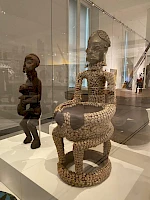
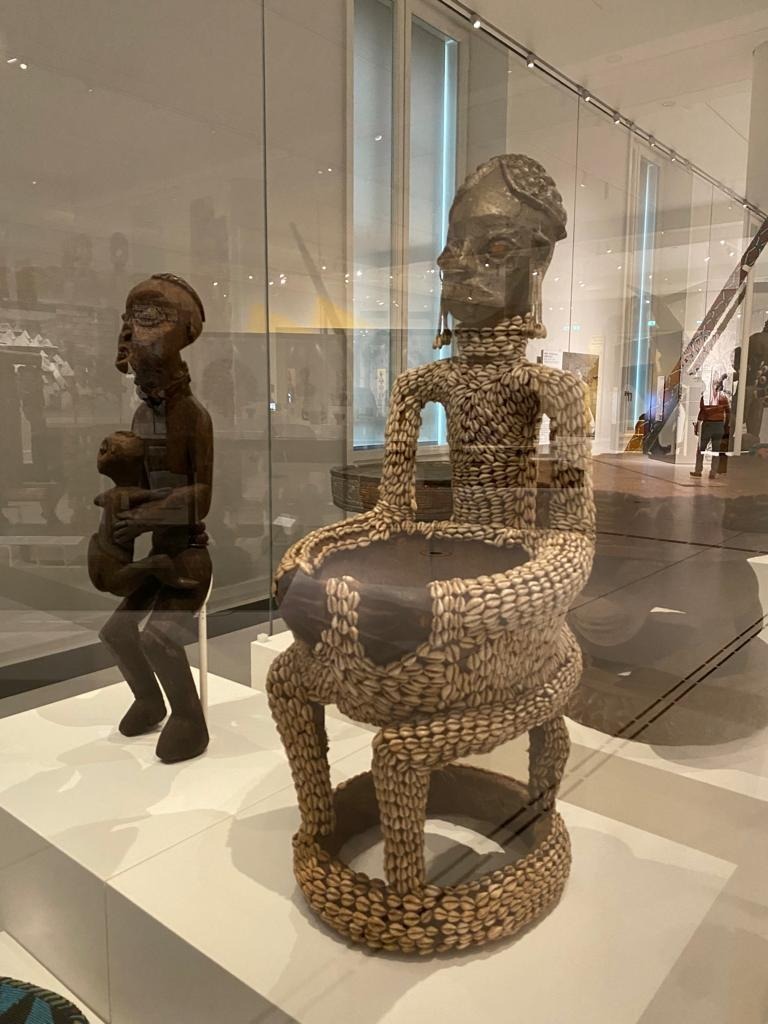
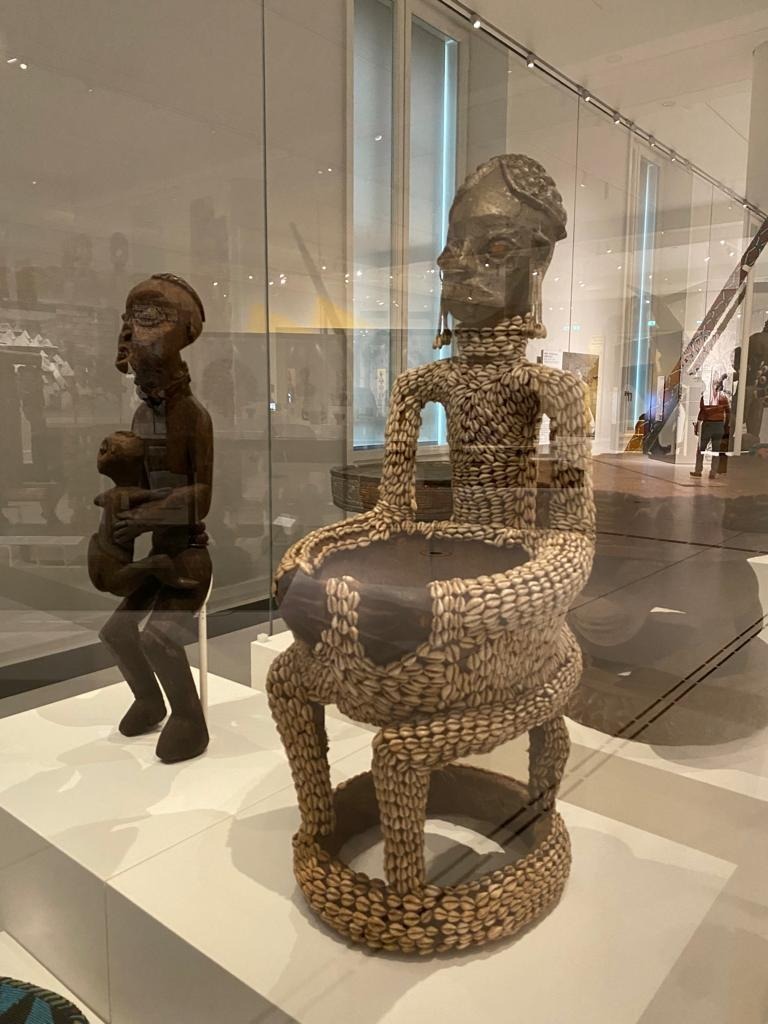
Photograph caption: Statue of Ngonnso, founder of the Nso kingdom in Northwest Cameroon, exhibited in the HUMBOLDT Museum in Berlin until Summer 2022. The German government announced the restitution of the statue in June 2022. Fogha, 2022.
This text is the result of a conversation recorded in September 2022 after the Dekoloniale festival and several round tables co-organized by the “Reconnecting ‘Objects’” research group. These events took place during the 12th Berlin Biennale for Contemporary Art curated by artist Kader Attia and moderated by Marie Helene Pereira. The collective debates on restitution, reparation, and colonial memory fueled our conversations. Reworked multiple times, this is a hybrid text: it began as a discussion about Fogha’s positions, led to the intermingling of our voices, and gave us perspectives on our research.
Conceived as a necessary response against colonialism, 20th-century “on the ground” decolonization seems to have been replaced by a new, increasingly institutional phase. Since the early 2000s, social engagements about collective memory, research led by people of all genders1* and denunciations of a persistent, exploitative system, have generated reflections on decolonization. These reflections have progressively spread to universities, museums, and even the political agendas of former colonial powers.2
This process includes many contradictions. Debates are equally inscribed in the capitalist economies of Europe and Africa through access fees to theoretical contents, anticipated compensation for the restitution of objects (for example, increased tourism, as recent developments in Benin demonstrate), or research funding on related topics from Western multinational corporations that nonetheless invest in African mining. Also, while the structures inherited from colonialism are currently used as intellectual space for reflecting on decolonization, they have often contributed to debates about “professionalism.” Professionalization, in this context, requires one to have specific qualifications in order to speak and act: one must have read this or that book, earned such and such diploma, or be able to speak the languages of the former colonial empires. There is real gate keeping in terms of speech, the right to participate in debates, and who is chosen to speak. Meanwhile, both supply and demand grow. Universities, museums, publishers, and the media increasingly seek out people from Africa or of African descent to talk about decolonization. This leads us to wonder about the consequences –in both Europe and Africa– of the ways non-Western concepts such as justice, art, or museum become transcribed. This article invites a reflection about these contradictions and their new visibility, which is notably generated by the dynamics of African artefact restitution.
Indeed, debates about decolonization have intensified since the late 2010s. Actions led by some European countries (France, the United Kingdom, Germany, Belgium, the Netherlands, as well as Switzerland3) to support the return of cultural objects4 looted during the colonization of Africa, have given a new visibility to debates about restitution. This process opened a space for reconsidering a shared history, that of colonization.5 It signals an historic but also political and epistemological break, as demands for artefact restitution, from the period of independence movements to present day, have summarily been dismissed. In Europe, so-called art and ethnography museums built on colonial collections are currently presented as prime institutional spaces for reflecting on colonialism and/or decolonization. Research projects and exhibitions6 have emerged that explore how objects were collected, where they came from, how they are exhibited, or even how they are currently classified. However, it is important to take a step back and examine why museums became emblematic spaces for reconsidering the colonial past.
The history of museums is closely tied to colonialism; in their own way, they contributed to colonialism by stabilizing it. The first ethnographic museums, along with 19th-century world exhibitions, were used to legitimize the “civilizing mission” carried out by colonial conquests and to consolidate visitors’ adherence to imperial ideologies through the exhibition of cultures and objects from the colonies. The latter, which was typically exhibited in a stereotypical and simplifying manner that adhered to ethnocentric criteria and arbitrary classifications, didn’t reflect the social and cultural realities of the people to whom they belonged.
Many Western museums receptive to postcolonial reflections are thus undergoing in-depth reassessments that could lead to redefining artistic, cultural, and esthetic concepts. These reassessments have followed many debates on the development of colonial and postcolonial museums in Africa, for example under the auspices of the AFRICOM program launched in 1991. However, the situation is more complex. In some cases, museums seem to have shifted from punitive expeditions to what Fogha Refem calls “punitive exhibitions.” Similar to “white centric exhibitions”7 that display the history of slavery based on plantation organization and/or that focus on the world of White people and oppressors, “punitive exhibitions” hinge on glorifying narratives of colonial conquests, flaunting objects as spoils, omitting clear explanations about origin, and on the continued use of staging devices that reify objects. Even now, some Western museums as well as African museums continue to operate as physical structures of coloniality. The Humboldt Forum, an ethnology museum newly opened within the reconstructed walls of a Prussian castle in downtown Berlin, could be seen as an example of “colonial punishment”8 still in operation, as Fogha suggests.
Restitution, as it is currently being implemented, undeniably generates asymmetry. First, it casts African societies out of the process. As debated in a panel discussions during the 12th Berlin Biennale, the restitution principle implies that the party restituting is not the party claiming. Currently presented as an act of reparations or as “the creation of a new relational ethics” between Europe and Africa, restitution generates a dynamic that relies on Europeans’ willingness, feelings, wishes, and legislation. The former colonial powers determine how they want to further address this injustice. As for the communities that were despoiled of their possessions, they are left with only a restricted power of decision and action.
This asymmetry also derives from the fact that the debate is centered on returning objects, while it usually conceals how the objects arrived in Europe. Yet these objects could have come from “punitive expeditions” during which many people were killed. The reparation and rehabilitation of this history must be told and must include the story of these objects, as well as the story of the objects that were destroyed during colonial aggressions.
Hence, restitution, as it is now being carried out, doesn’t seem to us to be a solution or a reparation because it doesn’t sufficiently break away from the established structures of asymmetric power. How can we think about restituted objects with their excess of identity; that is, with the tears and lives of the people who made them, and with the stories of the people who worked for their return? The debates on restitution only reveal the tip of the iceberg, since there could be some 500,000 African objects in Europe.9
More broadly, the debates on restitution will likely become obsolete quite soon, if they do not involve an in-depth reflection on the perpetuation of the colonial past in contemporary Africa. This currently manifests in land appropriation, mineral extraction throughout the continent by multinational corporations, the shameless pollution of water and land resources, among many other practices. These facts show another dimension of coloniality, namely the still active, colonial and capitalist conception of the natural environment as a material resource, the consequences of which are dramatic. If museums in Europe serve as an intermediary for civil society to disseminate new political debates on collective memory, particularly discussions about the restitution of cultural artefacts, they also control, at the same time, the conversations. Whereas debates on looted objects are enthusiastically welcomed, any denunciations of extractivism and land exploitation by multinational corporations (mainly from Europe, the U.S., China, and India) are obscured by this colonial debt.
The promoters of the Humboldt Forum thus created a “store” to “examine colonialism.” Unfortunately, one must wonder whether this space serves to dismiss a problematic history by boxing it up, by rendering it more palatable. This is all unfortunate, because the moment Western museums began to return objects, they could have engaged in self-reflection and asked themselves how they could survive without these objects. Addressing these important questions could lead European societies to change, transform, and ensure that they don’t repeat the same processes of predation and violence.
We think it is important to understand museums as spaces that colonize minds, concepts, and practices. Museums have conceptualized Africa as a continent contained within its “material culture.” While restitutions should be commended and necessary, that doesn’t mean, however, that African societies can’t live without these objects. Formerly colonized communities have certainly reinvented their lost heritage. They have created again, they have generated new artefacts. By maintaining contested categories–such as “African culture”, “Bamiléké sculpture”–the current restitution process contributes to confining “Africa” in an immutable temporality. In other words, museums are causing African ghosts to resurrect, but they are not invested in creating spaces for people, mainly African people, to live in the present. Rather, they resuscitate a dead and past Africa (with its history shaped by the Western prism) that ends up curtailing the rebirth of African societies. How can we create a “plan” for the future by examining colonizing processes? Debates aren’t currently oriented towards Africa and its future. Instead, they appear to serve European museums. Nevertheless, the return of objects should enable us to reconsider past events and to reflect on writing history from within, a history which colonialism has kept in the dark. Returning objects is necessary for African perspectives, traditions, and cultures to come back to light. So, how can we take advantage of restitutions to develop “our” own exhibitions, “our” own museums? Two Beninese museums that are currently being built and that are expected to receive restituted objects –the International Museum of Memory and Slavery (MIME) in Ouidah and the Museum of the Epic of the Amazons and Kings of Dahomey (MURAD) in Abomey– reveal influences, reliance, and even the Western grip on the construction of these new spaces. They are financed by the IMF and the AFD (“Agence Française de Développement”), designed by French architects, and built by Western and Chinese firms. Local firms are often excluded from bidding on these projects, as they are deemed incompetent. The country’s architectural and esthetic culture, and more broadly, non-Western knowledge, are not considered. What would museums be like if they were not based on Eurocentric museographic and scenographic concepts? A few attempts have been made, however they are too few.
Following Achille Mbembe’s reflections10 on the impossibility of representing and institutionalizing the enslaved figure, and of transforming it into a museum object, we must ask if organizing an exhibition on decolonization that is decolonial and decolonized is even possible? Indeed, decolonizing doesn’t mean creating things, rather it means freeing oneself from objectification in order to articulate the need for justice and memory, as well as historical, spiritual, and cultural transmission. Thus decolonization cannot be reduced to simply returning objects.
On the contrary, restitution –or at least reclaiming looted objects– represents a first step in the emergence of an Indigenous decolonial process. It could become the “restitution” of “the indigenous decolonial world-making agenda.” How African communities think, recall, express, or conceptualize decolonization is essential. During the struggles for independence, African leaders like Thomas Sankara or Kwame Nkrumah, along with grassroots movements, initiated anticolonial movements. For example, several women’s uprisings in Cameroon after 1954 gained traction as anticolonial movements, as Meredith Terreta,11 among others, describes in her research.
Anticolonial resistance is not only “theoretical” in Africa. It often occurs in spaces outside of universities and museums, without being labeled as decolonial. For example, the word “decolonization” is rarely uttered in music, while emancipation, freedom, autonomy, and conquest are ideas expressed as powerful actions, as movements and rhythm. This is evidenced in Ibrahima Wane’s research describing the role of folk songs in Senegal during the colonial and postcolonial periods.12 Their engaged lyrics questioned colonial or political order, and called for the use of local languages (Wolof, Peul, Diola) to reach a larger audience. After having been used for colonial propaganda, African radios became conduits for African people’s resistance and mobilization.13
Fogha’s research14 encourages a continued decentering approach, rooted in the history of the Nso realm (in Northwestern Cameroon) founded by Queen Ngonnso. After her death, her image was carved into a statue and a spiritual force was bestowed upon it. It was stolen in 1902 during what was considered a “punitive” German colonial expedition, in which the royal palace was burnt down and 800 people were killed. Subsequently, a song was written by Yaa Shongka, a Nso princess. This song, as most traditional Nso songs, doesn’t have a specific title. It is sung in a traditional style known as Chong, which is both a musical genre and a women’s sacred worship practice. This song, like many other Nso songs about colonization, tells the story of Germans invading and burning the Nso palace, and laments the pillaging and murdering that accompanied the invasion. The song is performed in a circle. It has been sung in various places and by different people but has always been danced and performed in the same manner. This song recounts the creation of a fleeting and unstable world, although open, world. It is a world that fosters relationships among people, whatever their gender. It is also heard as a battle cry inviting people not only to dance to its rhythm, but also to use the song as a motive for decolonial action by demanding accountability from former colonizers and those who sympathize with colonialism.
Since the late 1990s, and after Professor Bongasu Tanla Kishani discovered the statue of Ngonnso at the Ethnological Museum of Dalhem in Berlin, the Nso community and its diaspora have mobilized to demand its return.15 After three decades of requests, appeals, and demonstrations, the German government announced that it would return the sculpture in June 2022. In August 2022, during an annual gathering of the Berlin and Brussels Nso community, Nso children who were born in Europe and had never seen Ngonnso–the object or the subject–were offered a workshop. They were asked to draw Ngonnso, and when they did, they drew Ngonnso, in the glass showcase, since they had only ever seen the object protected by glass. However, they represented Ngonnso in very different ways. Hence, object reactivation doesn’t mean that the objects should be used again in the same manner. These different representations can inspire new creations, and develop a new societal imaginary disentangled from Europe. There are now two objects: the showcase and Ngonnso. The showcase represents Europe, and Ngonnso the community. This duality offers the opportunity to shape a new society that could surpass what it was in the past and what it became through European contact, which has been a source of new connections. It becomes an opportunity to shape a world to come and to create beyond a still active colonial dichotomy.
In other words, restitution cannot truly be effective when it is limited to a simple “return of artefacts that have become artworks.” It must be thought as a restitution of objects “in excess of themselves,” that can conceive the object as a subject–of conversation, in exile, with a consciousness.
Thinking about restitution connects distant communities: it could foster a transnational “cosmopolitanism,” a space for dialog that could bring together African and European ontologies –a cosmopolitanism that is not universal, but subjective, decentralized, or pluri-centered.
-
TN: the French-language version of this text uses inclusive writing as a way to acknowledge gender diversity. As the French government refused to officialize inclusive writing, the authors’ choice to use inclusive writing here is a political stance. The translator indicates inclusive writing through explanations when possible, however at other times, translation might gloss it out. ↩
-
We note here that in 2006, in Bolivia, Evo Morales Aymala’s government created a vice-ministry of Decolonization within the Ministry of Cultures. The goal of this new administration was to decolonize public institutions. ↩
-
Italy didn’t have a long period of large-scale colonization, returned the Obelisk of Aksum to Ethiopia in 2025 after several restitution requests. This restitution didn’t lead to the creation of a specific committee for the restitution of artwork looted during the colonial era. ↩
-
Since not everyone shares a common terminology for the word “object,” it encompasses here the esthetic, functional, and spiritual charge of these objects, as well as their multiple configurations (consecutively or sometimes simultaneously artefacts, tools, artworks, ritual objects, etc.). Britta Lange uses the expression “sensitive object” and Souleymane Bachir Diagne speaks about “mutant objects.” However, we are aware that, like many words repurposed by non-Westerners today, the “object” category doesn’t correspond to existing concepts or operating categories in the country where these objects were produced. ↩
-
Regarding restitution stakes, see: SARR Felwine & Benedicte SAVOY. Rapport sur la restitution du patrimoine culturel africain. Vers une nouvelle éthique relationnelle. 2018. ↩
-
See, for example, the permanent exhibitions of Nantes’ History Museum (France) with “the decolonial season,” the Museum of Tervuren (Belgium) and the Tropen Museum (Tropics Museum). “Unframing colonialism” at the Centre Pompidou in Paris (Nov. 2022-Feb. 2023), the Berlin Biennale, “Decolonial identities. From Africa to Mons,” at Mons Memorial Museum (Belgium, May 2022-May 2023). ↩
-
Eichstedt, Jennifer and Stephen Small. Representations of Slavery: Race and Ideology in Southern Plantation Museums. Washington, Smithsonian Press, 2002. Instead, the “Black centric” narratives unfold the violence suffered by enslaved people or the strategies of resistance and resilience they implemented. ↩
-
Wan wo Layir [Foha Refem], “The Palace we go to die: From Punitive Expeditions to Punitive Exhibitions,” Humboldt Forum Magazine [online], 2022. https://www.humboldtforum.org/en/magazine/article/the-palace-we-go-to-die-in-from-punitive-expeditions-to-punitive-exhibitions/ ↩
-
According to the Sarr-Savoy report, the Royal Museum for Central Africa (Belgium) could hold 180,000 stolen objects, the Humboldt Forum 75,000, the Musée du Quai Branly (France) 70 000, the British Museum (UK) 69,000, and the Weltmuseum of Vienna (Austria) 37,000. ↩
-
Mbembe, Achille. “L’esclave, figure de l’anti-musée?” [The Enslaved as Anti-Museum Figure?]. Africultures, no 91, 2013, p38-42. See also: Mbembe Achille. Politique de l’inimité. Paris, La Découverte, 2011. ↩
-
Terretta, Meredith. Petionning For Our Rights, Fighting For Our Nation: The History of the Democratic Union of Cameroonian Women, 1949-1960. Bamenda, Langaa RPICG, 2013. ↩
-
Wane, Ibrahima. “Chanson Populaire et conscience politique au Sénégal; l’art de penser la nation” [Folk Song and Political Consciousness in Senegal: the Art of Thinking a Nation]. Doctoral Dissertation, Cheikh Anta Diop University, Dakar, 2014. ↩
-
Camara, Bangaly. De la ‘Radio banane’ à la voix de la révolution: L’expérience radiophonique en Guinée [From “Banana Radio” to the Voice of the Revolution: the Radio Experience in Guinea]. Éditions L’Harmattan, 2017. ↩
-
Fogha Refem’s doctoral research contributes to this exploration of new epistemologies. Refem’s research, titled “Ontologies in Conversation: Restitution As a Cosmopolitan Practice,” focuses on Nso community’s alternative narratives about restitution and colonial memory. ↩
-
For a chronology of actions, see also report titled Bring Back Ngonnso (2021) by the association “Sysy House of Fame.” https://sysyhouseoffame.org/2021/10/21/bringback-ngonnso-campaign-the-report/ ↩